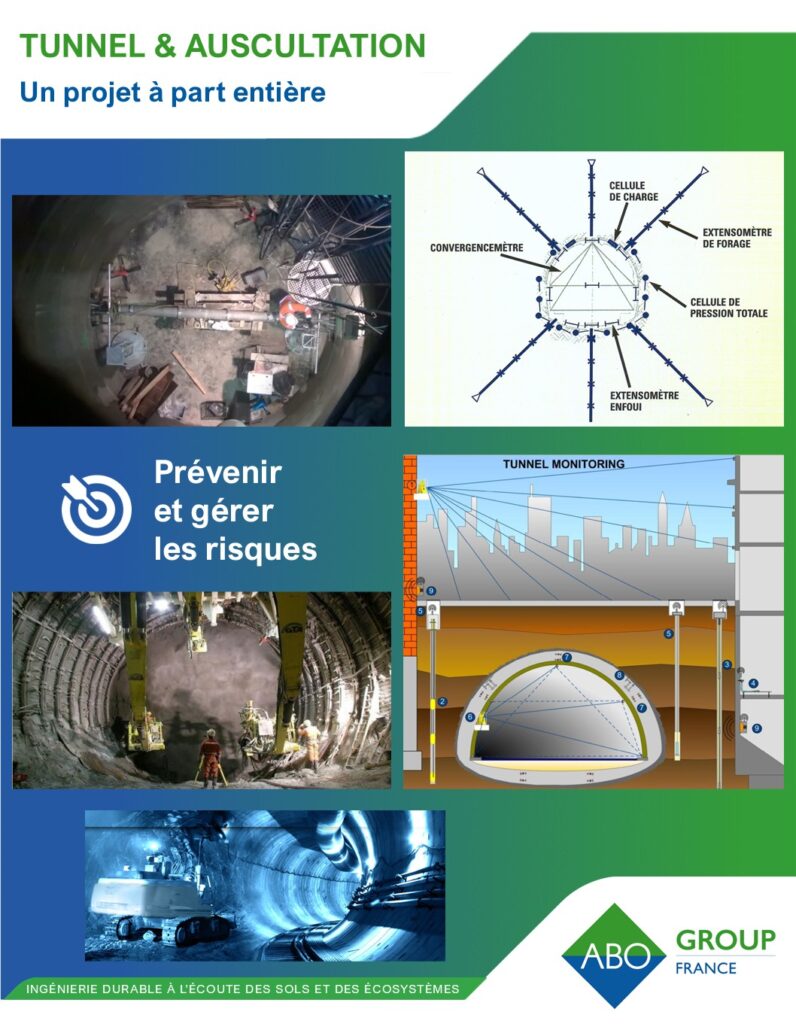
‘Auscultation’ is a project in its own right in a tunnel project, whether deep or underground, to prevent and manage risks.
This is the message conveyed by the teams at ABO Dynaopt to professionals attending the continuing professional development course on «Geotechnics for Tunnels» at the École des Ponts.
Why inspecting a tunnel is essential
- Geological and hydrogeological conditions at the site
- Geotechnical characteristics of the strata traversed
- Site-specific constraints in tunnelling, from shallow urban structures to deep tunnels
This could therefore minimise the need for auscultation. However, Monitoring a tunnel is essential to meet safety requirements and minimise damage to the structure :
- The geological and geotechnical data for the site are complex: some geological details may appear minor and risk going unnoticed during site surveys… yet their impact on the project may be significant.
- Models tend to simplify representations of natural conditions.
Monitoring to understand the behaviour of the structure
To auscultate means to measure changes in physical parameters in order to understand, and indeed control, the behaviour of the structure and its impact on its environment.
The survey therefore covers the geotechnical influence zone (ZIG):
- Neighbouring structures
- The sloping ground
- The book itself
The type of structure (deep or subsurface), the construction method and the nature of the ground will influence the scope of the parameters to be measured:
- Geometric parameters
- Hydraulic parameters
- Mechanical parameters
What a tunnel inspection checks for
Ultimately, a physical examination allows the following aspects to be assessed:
- Design assumptions – Initial state
- Behaviour of tunnels, galleries and structures under construction
- Impact caused by tunnel excavation and the construction of structures
This training is essential to remind us that health checks are not an end in themselves: they are a tool for managing and preventing risks.